John D. Rockefeller

1839
- 1937
Founder Standard Oil
Founder Standard Oil
John Davison Rockefeller was
born July 8, 1839 on a farm in Richmond, New York. He was the second
child of six born to William Avery and Eliza Davison Rockefeller. The
family lived modestly, John’s father being a “pitch man” charging up to $25.00
for treatments for cancers. His father traveled and was gone for
months at time and John’s upbringing fell mainly on his mother, who was very
religious and disciplined. She taught her children to work, to save
and to give to charities. After moving to Moravia and later to
Owego, New York, the family moved to Ohio in 1853. They bought a
house near Cleveland, in Strongsville, Ohio and John attended Central High
School in Cleveland. John left high school in 1855 and took a six-month
business course at Folsom Mercantile College. He completed the
course in three months and began searching for a job as a bookkeeper or clerk
in Cleveland. In 1855, business in Cleveland was adverse and John
had trouble finding a job. After six weeks, Hewitt & Tuttle, a
small company of produce shippers and commission merchants employed him as an
assistant bookkeeper. Rockefeller worked hard and impressed his
employers, arranging complicated transportation deals moving freight by
railroad, canal and lake boats. He began to trade for his own
account and his combination of caution; precision and resolve brought him to
the attention of the Cleveland business community.
 |
|
By: Stanley Yavneh Klos
Edited By: Naomi Yavneh Klos, Ph.D.
|
In 1859, several months before his 20th birthday,
Rockefeller entered into business for himself, forming a partnership with a
neighbor, Maurice Clark. Each man put up $2,000, John had $1,000 he
had saved and he borrowed the other $1,000 from his father. Due to
Rockefeller’s natural business abilities, Clark & Rockefeller earned a
small profit their first year in business and the company became very
successful. Their business expanded rapidly during the Civil War and
the company continued earning a profit for the two partners. In
1863, Rockefeller and Clark entered the oil business as refiners. Cleveland
had become a major refining center for the booming new oil industry. Together
with a new partner, Samuel Andrews who had experience in oil refining, and two
of Maurice Clark’s brothers, they built Andrews, Clark & Co. The
five partners disagreed about financing the company’s expansion and in 1865,
Rockefeller bought the interest of the Clarks for $72,500 and with Andrews,
formed Rockefeller & Andrews. Rockefeller, at the age of 24,
leveraged the business and expanded intensely. He plowed all his
profits back into the business and took decisive steps to strengthen his
company. In 1866, John brought his brother William into the business
to manage the New York City office and handle the export business.
In 1870 he organized The Standard Oil Company with his brother
William, Samuel Andrews, Henry M. Flagler, Stephen V. Harkness and O. B.
Jennings. Rockefeller felt the state of the oil business was in
disarray. Entry costs were low and the market was glutted with oil
and a resulting high level of waste. He felt the inefficiency of the
smaller firms, in their attempts to survive, drove the prices down below the
production costs and hurt the larger more efficient firms like his own. His
solution was one large company, vertically integrated, controlling the refining
and storage of oil, and the manufacturing of ancillary products such as paint
and glue. By 1872, Standard Oil had purchased and controlled
nearly all the refining firms in Cleveland. Standard Oil prospered
and all its properties were merged in 1882 into the Standard Oil Trust, which
was effectively one giant company.
In 1896, Rockefeller decided to give up leadership of the
day-to-day business of Standard Oil and focused his efforts on philanthropy. Ever
since he was a boy following his mother’s teachings, he had contributed to his
church and other charities, and from the mid 1890’s until his death in 1937,
Rockefeller’s activities were all philanthropic. Rockefeller hired
the Reverend Frederick T. Gates who had worked with the American Baptist
Education Society and the University of Chicago to help him manage his
philanthropy. In 1897, his son, John D. Rockefeller, Jr. assisted
Gates and with their advice, Rockefeller established a series of institutions
that are important in the history of American philanthropy, science, medicine
and public health that continues today.
Rockefeller died on May 23, 1937 at the age of 97. He
is buried in Lakeview Cemetery in Cleveland.
John D. Rockefeller


By: Trentwell Mason White - 1920
JOHN D. ROCKEFELLER'S first business
experience was at the age of eight, when he became the owner of a few turkeys.
At once he was confronted with certain hard realities of life that had never
occurred to him. He had no money — yet he had to supply the birds with food! It
was in a way an amusing predicament he was in — for his livestock threatened to
turn out a white elephant. His mother, however, came to the rescue, presenting
him with the curds from the milk to feed them. This solved the boy's problem,
and, as he took care of the birds himself, their keep cost him nothing. After a
while he sold his turkeys in a businesslike way, the money he received for them
being all profit.
John was only a little boy when he
conducted this, his first commercial transaction, but it was a valuable lesson
in business, for he learned that capital is necessary to conduct any kind of
business. This gave him some idea of the value of money (capital), and led him
into habits of thrift. Later on in life when asked, at his fine home at
Pocantico, how he managed to buy such a large and fine estate, he replied:
"By saving my pennies."
The richest man in the world's earliest
philanthropic work was in lifting the mortgage from his home church. His
parents were Baptists and, from his earliest age, John had taken a great
interest in church work. He was a constant attendant, and soon became a leader
among the young people. When only eighteen he was elected a trustee of his
church. For some years the church had been struggling along under a debt of
$2,000. One Sunday, to John's horror, the minister announced that the mortgage
was about to be foreclosed, and that unless the congregation quickly raised
$2,000 they would lose their church building.
The announcement made a profound
impression upon the youth, and, after the service, he posted himself at the
church door, and buttonholed the worshipers as they came out, insisting upon
getting from each one of them a promise of a contribution toward canceling the
debt. He continued his campaign for some months, and a proud day it was for
John D. Rockefeller when he collected the last cent, and the mortgage was burnt
amid general rejoicings. This was, Mr. Rockefeller said once, the hardest work
he ever did!
As a boy the future Oil King was brought
up in the good old-fashioned way. "Spare
the rod, spoil the child," was his mother's motto, and she proved a "good deal of a disciplinarian,"
upholding the standard of the family with a birch switch whenever it showed a
tendency to deteriorate.

He was, for example, once soundly whipped
for something he didn't do. After the whipping, when he was able to explain,
his mother said: "Never mind, we
have started in on this whipping, and it will do for the next time."
On another occasion, John and the boys
with whom he used to play went skating by moonlight — something he was
forbidden to do. No sooner had they got started than they heard a cry for help,
and found a neighbor who had broken through the ice and was nearly drowned. By
pushing a pole to him, the boys saved his life, restoring him safe and sound to
his grateful family.
John and his brother William thought
that because of this episode, the saving of this man's life, they would be "let off " and not punished
for their disobedience. But, to their dismay, the idea proved to be erroneous!
The birch was had in requisition as usual.
In this way was the habit of absolute
obedience sternly drilled into the Rockefeller children.
Mr. Rockefeller is a native of Tioga
County, New York, his grandfather, Godfrey, coming from Massachusetts and
settling in Richford. In this village John Davison Rockefeller was born on July
8, 1839. While a child his father, William A. Rockefeller, drifted here and
there, finally settling in Cleveland, Ohio, where he built a house for the
family.
By this time, John, his eldest son, was
a lad of fourteen and had had about the same boy-experience that falls to the
lot of most boys. He had attended district school and done such work as
chopping wood, taking care of horses, milking cows, weeding the garden, raising
chickens and turkeys. He was, however, a silent, secretive sort of boy and
never mixed with other youths. He went about things in a somewhat earnest and
solemn way, but, whatever he had to do, he usually did well.
His father was tall and fine-looking,
with a dominating personality, a great hunter and an unusually fine shot. He
was, too, a very shrewd, practical man and Mr. Rockefeller has often acknowledged
owing a great debt to his father for training him in practical ways. He was
engaged in numerous enterprises, large and small, about which he used to talk
very freely to his son John, explaining their significance; in addition, he
tutored him in the principles and methods of business.
As a result of his early business
training, the boy kept a little book, which he called "Ledger A," in which he used to set down all the money he
made and all the money he spent, and also all sums he had given away in charity
— for he had been taught to give regularly a certain percentage of his receipts
to charitable objects. This little ledger is still in Mr. Rockefeller's
possession and he is said to prize it above rubies.
It was the intention of his parents to
send John to college, but he was anxious to go to work, so when he reached the
age of sixteen he was taken from the high school where he had almost finished
his course and sent to a commercial college in Cleveland. Here he was taught
bookkeeping and some of the fundamental principles of commercial transactions,
and this training, though lasting only a few months, proved of great value to
him.
John's education being finished, the
next thing for him to do was get a job. This was by no means easy, however. "I tramped the streets for days and
weeks," Mr. Rockefeller relates, "asking
merchants and storekeepers if they didn't want a boy." But no one
seemed to need a boy, and "very few
showed any overwhelming anxiety to talk with me on the subject. At last one man
on the Cleveland docks told me that I might come back after the noonday
meal."
He was in a fever of anxiety lest he
lose this opportunity, but when, betimes, he presented himself to his
prospective employer, he said: "We
will give you a chance." This was on September 26, 1855, and no word
was said about pay.
John went to work joyfully and with much
energy and enthusiasm. When January came, his employers, Hewitt & Tuttle,
gave him $50.00 for three months' work. These were his first real wages and the
amount, $50.00, seemed to the boy almost a fortune. The firm was a wholesale
produce commission and forwarding concern and John's work was clerical, in the
office, under a bookkeeper who was a fine executive and disciplinarian and who
received $2000.00 a year in lieu of the profits of the firm of which he was a
member.
Beginning with the new year, John's
salary was raised to $25.00 a month and when at the end of the year the
bookkeeper left he took his position and did the work at a salary of $500.00 a
year.
As the firm's business was general and
very extensive, young Rockefeller got an unusually valuable experience in
business. It was not long before he began to audit accounts and make himself
useful in all sorts of business negotiations. In the passing of bills,
collecting rents, adjusting railroad, canal and other claims, he met all sorts
of people, against some of whom he often had to pit his own shrewdness, and all
this increased his business knowledge and efficiency.
The next year he was offered a salary of
$700.00, but considered that he was worth $800.00. When April came, this salary
matter not having been settled, he resigned because of an opportunity he saw to
go into the same business for himself. This opportunity came about in this way:
Among the merchants in Cleveland, whose acquaintance he had made, was a young
Englishman, M. B. Clark, who at this time wanted to enter business for himself
and was looking for a partner. He had $2000 and was looking for a man with a
like sum. Young Rockefeller had been very thrifty, jut he had only saved about
$800, and didn't know where to get the balance. On talking over the matter at
home, however, his father told him he had always intended to give each of his
children $1,000 when they reached twenty-one. He offered to give John his share
then and there if he would pay him interest at the rate of ten per cent. until
he was twenty-one.
Students and Teachers of US History this is a video of Stanley and Christopher Klos presenting America's Four United Republics Curriculum at the University of Pennsylvania's Wharton School. The December 2015 video was an impromptu capture by a member of the audience of Penn students, professors and guests that numbered about 200. - Click Here for more information
Needless to say, John gladly accepted
his father's offer, and the new firm of Clark & Rockefeller was launched. "It was a great thing to be my own
employer," Mr. Rockefeller once said. "Mentally I swelled with pride — a partner in a firm with $4000
capital!"
Young Rockefeller was junior partner and
had charge of the finances and books. Mr. Clark attended to the buying and
selling. The firm at once began to do a large business, dealing in carload lots
and cargoes of produce, and before long needed more capital to handle their
growing business.
Mr. Rockefeller, as financial head of
the firm, had now to negotiate his first loan. In some fear and trembling he
asked the president of the bank for $2,000. His reply was: "All right, Mr. Rockefeller, you can have it. Just give me your
own warehouse receipts; they're good enough for me."
The fact that a bank was willing to loan
him $2000 greatly elated the young merchant, and he began to feel himself of
some importance in the community. He was a business man!

Mr. Rockefeller now began to go out and
solicit business, something he had never done before. In the course of his
drumming, he pretty well covered Ohio and Indiana. To the surprise of the young
partners, business increased so rapidly they could scarcely take care of it,
and their first year's sales amounted to half a million dollars.
Of course, they had to keep on borrowing
money as their business expanded, and young Rockefeller's loans from his
father*were many. Once in a while — usually at very awkward times — his father
would suddenly "call" a loan, saying: "My son, I find I have got to have that money."
"Of course, you
shall have it at once," John would cheerfully answer.
His father did not need the money, but
was simply applying a wholesome test, and in a week or two would offer it back
again. John was not particularly pleased, however, with his father's tests to
discover if his financial ability was equal to such shocks.
But it was very difficult in those days
to raise money for business enterprises, and John was glad to pay his father
the ten per cent. interest he charged him. This was the ruling rate in those
days, though considered too high by many.
Meantime, the produce business of Clark
& Rockefeller went on very prosperously and in the early sixties they
organized a new firm to refine and deal in oil. It was composed of James and
Richard Clark, Samuel Andrews and the firm of Clark & Rockefeller, who were
the company. Mr. Andrews, who had mastered the process of cleansing (refining)
crude oil with suphuric acid, was the practical man in the concern in charge of
the manufacturing. In 1865, however, the partnership was dissolved and after
settling the concern's indebtedness and collecting the money due it, it was
decided to auction off the plant and good will.
By this time, young Rockefeller had
waked up to petroleum possibilities. With the intuition of genius, he divined
in a flash the wonderful opportunities all around him in the refining of oil.
He saw the number of oil wells rapidly increasing and a great and growing
business springing up in oil. So he was seized with the desire to pull out of
his produce business, buy this oil plant and go into partnership with Mr.
Andrews.

The day of the auction arrived and the
bidding started in at $500.00. Young Rockefeller at once bid $1000, and then
the bidding slowly mounted to $72,000. Mr. Rockefeller, although he didn't
exactly know where he could get such a large sum from, at once bid $72,500.
Upon which, Mr. Clark, who headed the other faction, said: "I'll go no higher, John; the business is yours."
"Shall I give you
a check for it now?" asked Mr. Rockefeller.
To which Mr. Clark replied: "No, I'm glad to trust you for it;
settle it at your convenience."
And so, as Mr. Rockefeller so modestly
narrates in his recent book, "The
firm of Rockefeller & Andrews was then established and this was really my
start in the oil trade. It was my most important business for about forty years
until, at the age of about fifty-six, I retired."
The oil business turned out to be for a
long time a precarious and highly speculative business. The business of
refining oil was a comparatively easy one, and soon every Tom, Dick and Harry
was in the business. There was, too, an over-supply of petroleum and prices
went down and down. This over-production raised some great problems and one of
the most important and probably most difficult was to find foreign markets.
So the new oil firm found itself under
the necessity of increasing its capital, of securing the best talent and experience
obtainable, of buying the largest and best refining concerns, and of
centralizing the management to secure greater economy and efficiency and at the
same time a wider market.
Notwithstanding occasional setbacks, the
business of the enlarged firm grew at an unexpected rate, necessitating branch
refineries, storage tanks, agencies and large stocks at the most important
seaboard cities and later on came the tremendous feat of establishing
pipelines, through which the oil was pumped to markets at a great distance.
These pipelines, upon which the entire oil business is dependent, were followed
by other revolutionary improvements such as tank-cars and tank ships, the
latter, vessels especially constructed for the transportation of oil in bulk to
tropical and other countries.
In 1867, William Rockefeller & Co.,
Rockefeller & Andrews, Rockefeller & Co., and S. V. Harkness & H.
M. Flagler united in forming the firm of Rockefeller, Andrews & Flagler,
and this was really the starting point of the Standard Oil Co. Their reason for
thus combining was to secure greater economy and efficiency and a larger
business. As time went on and the vast possibilities of the oil industry became
clearer, they induced others to put in money, and organized the Standard Oil
Co. with a capital of one million dollars. This capital was increased in 1872
to $2,500,000 and two years later to $3,500,000. At the present time the total
capital of the Standard Oil Co. and its subsidiaries or allied corporations
probably exceeds a billion dollars.
A great many people have been lost in
wonder at the amazing growth of the Standard Oil Co. and some people have not
been backward in accusing it of unfair business methods. Mr. Rockefeller
himself only a few years ago said that he ascribed the success of the Standard
Oil Co. to "its consistent policy of
making the volume of its business large through the merit and cheapness of its
products. It has spared no expense in utilizing the best and most efficient
method of manufacture. It has sought for the best superintendents and workmen
and paid the best wages."
As a matter of fact, Mr. Rockefeller had
faith in American oil, and was successful in bringing together vast sums of
money to push it, against Russian and other competition, into every quarter of
the world. He also utilized the by-products of the raw oil, building up a vast
business in these alone, developing more than two hundred products of petroleum,
such as Vaseline, candles, etc. Every kind of transportation — elephants,
camels, burros, rafts, tank-vessels, Chinese and Indian coolies — helped in
illuminating the remotest quarters of the world with Standard oil.

About 1893 — the panic year — Mr.
Rockefeller became heavily interested in the iron-ore mines in the Northwest,
later on building a fleet of ships on the Great Lakes to market his ore. Still
later the whole immense properties were turned over to Mr. Carnegie's steel
company at a good price.
Mr. Rockefeller was led to use his brain
and money in these iron properties through the fact that he had, some years
previously, made some investments in the stock of iron companies. These proving
unremunerative, he got an associate, Mr. Gates, to go out there and report upon
them. The report being unfavorable, as to management, financial condition,
etc., he decided to buy out the owners, and operate the mines himself. His
judgment as to their possibilities was as usual correct.
"Going over again
in my mind," said Mr. Rockefeller once, the events connected with this ore experience
that grew out of investments that seemed at the time to say the least, rather
unpromising, I am impressed anew with the importance of a principle I have
often referred to. If I can make this point clear to the young man — it may be
benefit to him.
The underlying, essential element of success in business affairs is to follow the established laws of high class dealing. Keep to broad and sure lines, and study them to be certain that they are correct ones. Watch the natural operations of trade, and keep within them. Don't even think of temporary or sharp advantages. Don't waste your effort on a thing which ends in a petty triumph unless you are satisfied with a life of petty success. Be sure that before you go into an enterprise you see your way clear to stay through to a successful end. Look ahead. Study diligently your capital requirements, and fortify yourself fully to cover possible setbacks, because you can absolutely count on meeting setbacks. There is no mystery in business success — there can be no permanent success without fair dealing that leads to widespread confidence in the man himself, and that is the real capital we all prize and work for."
Mr. Rockefeller believes that
disinterested service is the road to success. To the boy or young man starting
out in life, he says:
If you aim for a large, broad-gauged success, do not begin your business
career, whether you sell your labor or are an independent producer, with the
idea of getting from the world by hook or crook all you can. In the choice of
your profession or your business employment, let your first thought be: Where
can I fit in so that I may be most effective in the work of the world? Where
can I lend a hand in a way most effectively to advance the general interests? Enter
life in such a spirit, choose your vocation in that way, and you have taken the
first step on the highest road to a large success.
The great fortunes made in this or other
countries, Mr. Rockefeller believes, have come to those men " who have
performed great and far-reaching economic services — men who, with great faith
in the future of their country, have done most for the development of its
resources."
As Mr. Rockefeller is doubtless the most
successful business man that ever lived, the boy or young man starting out in
life would do well to ponder seriously what so distinguished an authority has
to say about getting on in the world. Some young men jump from one occupation
to another in their anxiety to make a fortune rapidly and in the end get nowhere,
have nothing. Mr. Rockefeller's advice is, "Don't
change; just stick to one thing until you succeed at it ... do not be
discouraged, and save, save, save! Unless you practice thrift, you can never
become much. Lay aside every dollar you can, and after a while you will have
enough to start in business."
Mr. Rockefeller early in life learned
the value of money. He found that he could get as much money, in interest, for
$50 loaned at seven per cent as he could by digging potatoes for ten days. "I thus learned," he says, that it
is a good thing to let money be my slave and not make myself a slave to money.
. . . Make good bargains; save your money and let it work for you. Wed natural
ability to hard work and you have a combination that nothing can defeat.
The most successful men in our country
have been the men who have had confidence in the United States and its
resources as well as confidence in their fellow man. It has been the optimist
who has succeeded.
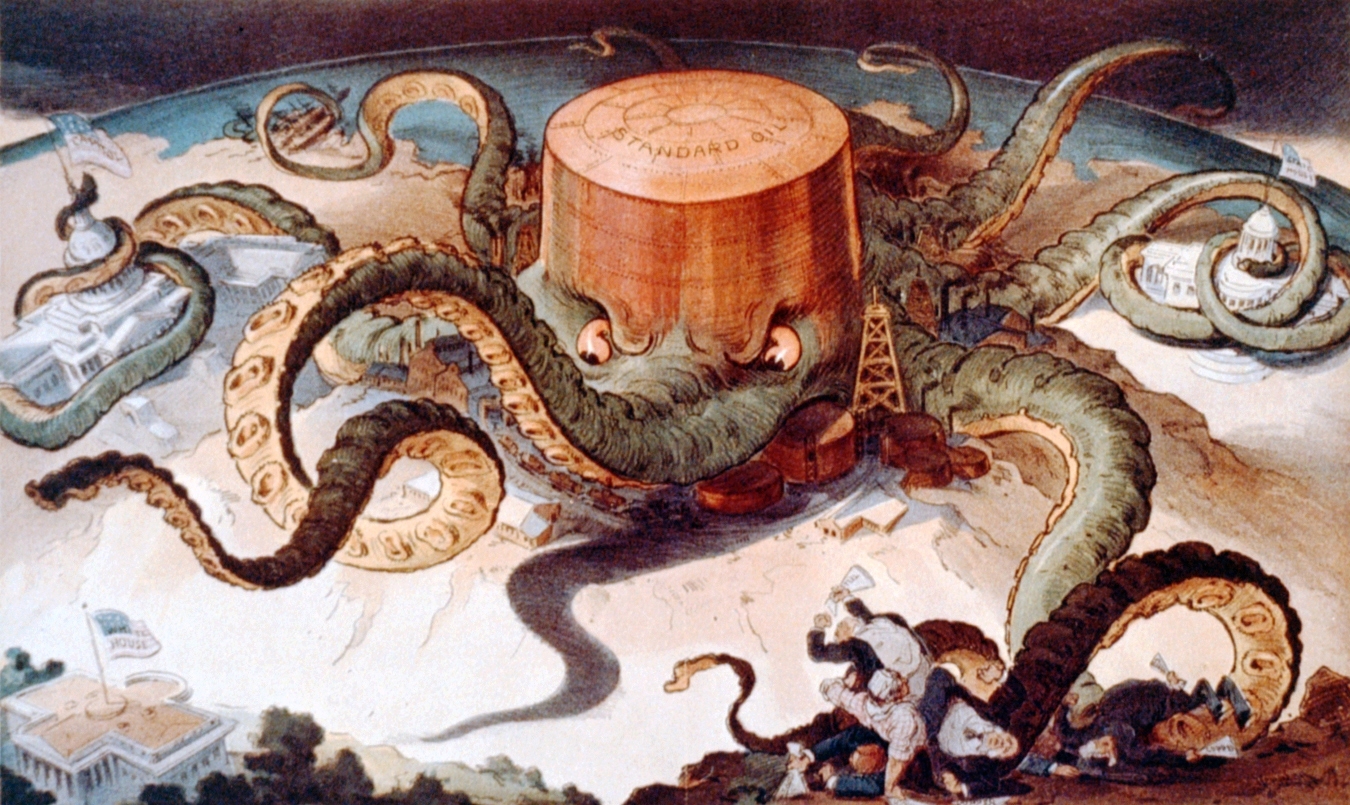 |
| Political cartoon showing a Standard Oil tank as an octopus with many tentacles wrapped around the steel, copper, and shipping industries, as well as a state house, the U.S. Capitol, and one tentacle reaching for the White House. by Udo J. Keppler (1872-1956) artist, Spublished by: J. Ottmann Lith, Co., Sept. 7th, 1904,lithograph, color. |
Mr. Rockefeller is no exception to this rule,
for it was his faith in one of America's greatest natural resources — oil —
plus his tremendous energy and courage, that placed our country in the first
rank of petroleum producers and made him — John Davison Rockefeller — America's
foremost business man and leader of industry as well as the world's richest man
and greatest giver to philanthropy.

727-771-1776 | Exhibit Inquiries
202-239-1774 | Office
Dr. Naomi and Stanley Yavneh Klos, Principals
Capitals of the United States and Colonies of America
Philadelphia
|
Sept. 5, 1774 to Oct. 24, 1774
| |
Philadelphia
|
May 10, 1775 to Dec. 12, 1776
| |
Baltimore
|
Dec. 20, 1776 to Feb. 27, 1777
| |
Philadelphia
|
March 4, 1777 to Sept. 18, 1777
| |
Lancaster
|
September 27, 1777
| |
York
|
Sept. 30, 1777 to June 27, 1778
| |
Philadelphia
|
July 2, 1778 to June 21, 1783
| |
Princeton
|
June 30, 1783 to Nov. 4, 1783
| |
Annapolis
|
Nov. 26, 1783 to Aug. 19, 1784
| |
Trenton
|
Nov. 1, 1784 to Dec. 24, 1784
| |
New York City
|
Jan. 11, 1785 to Nov. 13, 1788
| |
New York City
|
October 6, 1788 to March 3,1789
| |
New York City
|
March 3,1789 to August 12, 1790
| |
Philadelphia
|
December 6,1790 to May 14, 1800
| |
Washington DC
|
November 17,1800 to Present
|
Book a primary source exhibit and a professional speaker for your next event by contacting Historic.us today. Our Clients include many Fortune 500 companies, associations, non-profits, colleges, universities, national conventions, pr and advertising agencies. As the leading exhibitor of primary sources, many of our clients have benefited from our historic displays that are designed to entertain and educate your target audience. Contact us to learn how you can join our "roster" of satisfied clientele today!
Historic.us
A Non-profit Corporation
A Non-profit Corporation
Primary Source Exhibits
2000 Louisiana Avenue | Venue 15696
New Orleans, Louisiana, 70115
727-771-1776 | Exhibit Inquiries
202-239-1774 | Office
Dr. Naomi and Stanley Yavneh Klos, Principals
Naomi@Historic.us
Stan@Historic.us
Primary Source exhibits are available for display in your community. The costs range from $1,000 to $35,000 depending on length of time on loan and the rarity of artifacts chosen.
Website: www.Historic.us

Middle and High School Curriculum Supplement
For More Information Click Here
 |
| U.S. Dollar Presidential Coin Mr. Klos vs Secretary Paulson - Click Here |
